Baby Bib
First Impressions: Simple, Sweet, and Purpose-Built
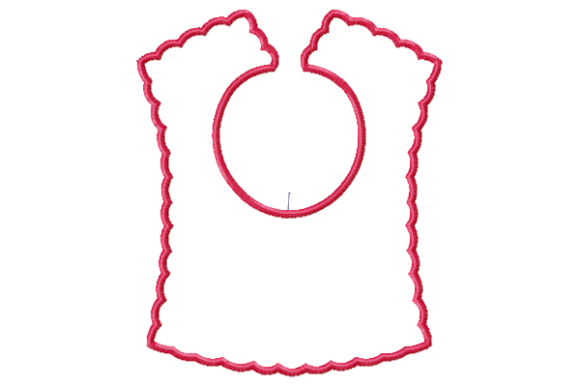
Opening the Baby Bib embroidery file, I immediately noticed its clean, open-outline structure — no heavy fills or dense satin borders. It’s not a decorative monogram or a whimsical scene; it’s a functional shape with quiet charm. The curve of the bib’s neckline flows smoothly, the bottom edge tapers gently, and the strap cutouts are generous enough for real hardware — not just decorative flourishes. This isn’t a “cute-for-cuteness’-sake” machine embroidery design. It feels like a tool first, an heirloom second. That balance is rare — and exactly what makes Baby Bib stand out in a crowded category of baby embroidery.
Real-Life Test: Turning Outline Into Heirloom
Last week, I used Baby Bib to stitch a set of three personalized bibs for a boutique client launching a nursery line. We chose soft organic cotton interlock — lightweight but stable — and paired it with high-quality tear-away stabilizer. The outline stitched cleanly in under 90 seconds per bib. No skipped stitches. No thread breaks. What surprised me most was how well the design held up after washing: the crispness remained, the curves stayed true, and the edges didn’t fray. Customers commented on how “delicate but durable” the finished product felt — a direct result of the design’s intelligent simplicity.
Where Baby Bib Shines (and Where It Asks for Care)
This isn’t a one-size-fits-all applique design. Its strength lies in context:
- Custom apparel & baby clothes: Works beautifully on onesies, swaddles, and burp cloths — especially when layered with minimal topstitching or a single-color satin border.
- Embroidered patch: Stitch it on medium-weight twill, then heat-seal or sew onto denim jackets, canvas totes, or linen aprons. The open shape lets the base fabric peek through, adding subtle texture.
- Holiday embroidery & personalized gifts: Pair with seasonal thread colors — sage green for baby showers, blush pink for spring, navy for gender-neutral gifting. It reads clearly even at 3.5" wide.
- Small shop product & Etsy seller asset: Because it’s an outline, it scales well across mockups — from digital embroidery file previews to printable mockups for your listings. Buyers instantly “get” its utility.
But be thoughtful where you place it:
- Thin or stretchy fabric? Use cut-away stabilizer underneath — the outline relies on clean edge definition, and wobble ruins the silhouette.
- Dark fabric? Test white or light ecru thread first. Some outlines vanish if contrast is too low, especially in satin stitch accents (if added later).
- Curved surfaces (caps, hats)? Avoid unless you’re using a cap frame and have tested hoop clearance — the strap openings can catch on hoops or cause puckering.
- Frequent-wash items (like daily-use bibs)? Confirm your thread is polyester or rayon with high washfastness. Cotton thread may fade faster around those fine outer lines.
Design Integrity Meets Customer Trust
As a designer who ships embroidered goods directly to parents, I pay close attention to how a design affects perceived value. Baby Bib doesn’t shout — it invites. When stitched cleanly, it signals care, intention, and craftsmanship. That matters. A buyer scanning your Etsy shop doesn’t just see a bib; they see a promise of softness, safety, and thoughtfulness. That emotional resonance comes from the design’s restraint: no overworked details, no visual noise, just confident, balanced form. It supports your brand voice instead of competing with it.
For craft business owners building cohesive collections — say, matching bibs, burp cloths, and blanket corners — Baby Bib holds its own as a unifying motif. It’s flexible enough to pair with script names, minimalist icons, or even tiny floral sprigs — but never overwhelms them. That versatility is gold for small shop product development.
Practical Designer Notes You’ll Actually Use
Before stitching your first Baby Bib into a finished product, do this — not as checklist busywork, but as professional due diligence:
- Test on scrap fabric — same weight and weave as your final project. Watch how the outline behaves near seams or curved hems.
- Review stitch density — especially if adding fill or satin elements later. Too much density on lightweight baby fabric = stiffness. Too little = fragile edges.
- Confirm hoop size compatibility — this is an ITH baby bib outline embroidery design, so check whether your hoop allows full strap clearance without re-hooping.
- Inspect small details — zoom in on the strap openings in your embroidery software. Are corners sharp? Are points defined? Blurry vector conversion can muddy that precision.
- Try black-and-white mockups — does the shape read clearly without color? If yes, you’ve got strong design bones.
- Use proper stabilizer — especially for textured fabrics like terry cloth or ribbed knit. A floating layer often helps maintain outline fidelity.
- Verify licensing — since this is marketed as a template for creating personalized bibs in-the-hoop, confirm whether commercial use (e.g., selling finished bibs or digital embroidery files) is permitted before scaling production.
Final Thought: Not Just Another Outline
Baby Bib succeeds because it understands its role: it’s a foundation, not a finale. It gives you space to add your voice — through thread choice, fabric pairing, or complementary elements — without demanding attention away from the handmade product itself. For embroidery designers, Etsy sellers, and small shop owners building trust one stitch at a time, that kind of quiet reliability is worth more than flash. It’s the difference between a quick stitch and something someone keeps.